

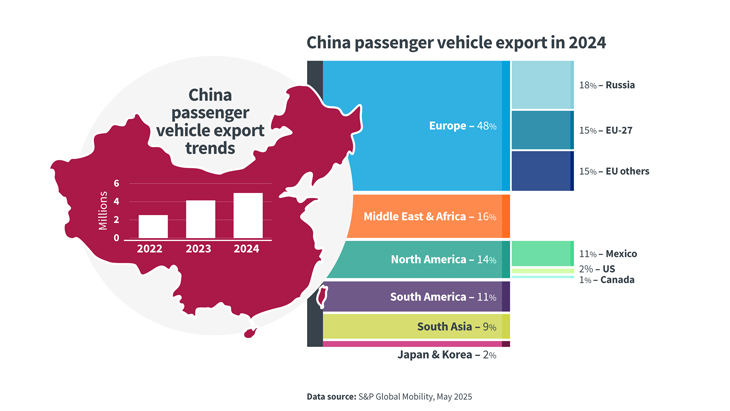
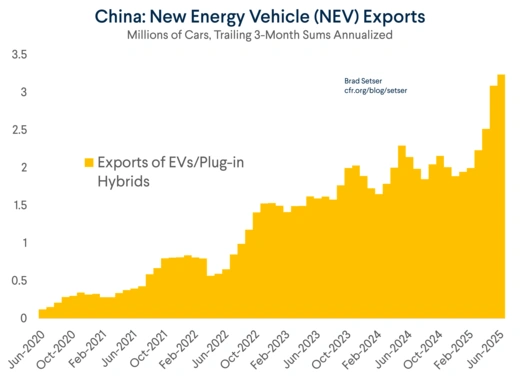
As of December 2025, China’s new energy vehicle (NEV) exports—including battery electric vehicles (BEVs) and plug-in hybrids (PHEVs)—have reached unprecedented levels. From January to November 2025, China exported approximately 2.315 million NEVs, more than doubling year-on-year, according to data from the China Association of Automobile Manufacturers (CAAM) and the China Passenger Car Association (CPCA). This surge solidifies China’s position as the world’s leading NEV exporter, driven by competitive pricing, advanced technology, and expanding global demand in emerging markets.
Chinese NEVs now dominate in many import markets, particularly in Southeast Asia and Latin America, where affordable models from brands like BYD, Chery, and SAIC have captured significant shares amid supportive policies and rising EV adoption.

Top Countries Importing Chinese NEVs in 2025 and Estimated Market Share
Based on cumulative data through October/November 2025 (CPCA and industry reports), here are the leading destinations for Chinese NEV exports. Market shares reflect the proportion of Chinese brands in local NEV sales, often exceeding 60-85% in emerging markets due to price advantages and limited local competition.
| Rank | Country/Region | Estimated Exports (Jan-Oct 2025, units) | Chinese NEV Market Share (Approx.) | Key Notes |
|---|---|---|---|---|
| 1 | Belgium | ~250,000+ | 40-50% (Europe re-export hub) | Primary entry point for Europe |
| 2 | Philippines | ~170,000+ | 60-80% | Fast-growing Southeast Asia market |
| 3 | United Kingdom | ~175,000+ | 30-40% | Mature European demand |
| 4 | Brazil | ~160,000+ | 65-85% | Dominant in Latin America |
| 5 | Mexico | ~150,000+ | 50-70% | Gateway to North America |
| 6 | Australia | ~124,000+ | 40-50% | Strong Oceania growth |
| 7 | Thailand | ~112,000+ | 75-85% | Policy-driven EV hub |
| 8 | United Arab Emirates | ~110,000+ | 50-70% | Middle East expansion |
| 9 | Indonesia | ~88,000+ | 60-80% | Emerging ASEAN leader |
| 10 | India | ~88,000+ | 30-40% | Growing despite tariffs |
Sources: China Passenger Car Association (CPCA), CAAM, Ember, and IEA Global EV Outlook 2025 estimates. Full-year 2025 exports projected to exceed 2.8 million units.
Chinese brands often account for 70-85% of NEV sales in markets like Brazil, Thailand, Philippines, and Indonesia, where imports fill gaps left by slower local production.
Charging Infrastructure Challenges in Key Emerging Markets
While Chinese NEV exports boom, many top import destinations face significant gaps in public charging infrastructure, leading to “range anxiety” and slower adoption. According to the IEA Global EV Outlook 2025 and Roland Berger EV Charging Index:
- Brazil, Mexico, Philippines, Indonesia, and Thailand: Public charger density remains low, with EV-to-charger ratios often exceeding 10:1. Highway coverage is incomplete (<80% in many areas), and rural/suburban networks are sparse. Rapid NEV sales growth outpaces infrastructure deployment.
- UAE and Australia: Urban areas are better served, but long-distance and remote charging is limited.
- India: Grid instability and low fast-charger penetration hinder progress.
These gaps create opportunities for innovative solutions that bypass traditional grid dependencies.

How XiaoFuPower’s Integrated Energy Storage Charging Products Address These Gaps
XiaoFuPower’s energy storage-integrated charging stations (storage + charging solutions) are ideally suited to overcome infrastructure bottlenecks in emerging markets:
- Grid-Independent Deployment: Off-grid or weak-grid capabilities allow rapid installation in rural areas, highways, and underserved regions without major upgrades.
- Peak-Shaving and Cost Optimization: Store energy during off-peak hours and discharge during peaks, reducing operational costs by 30%+ in markets with variable electricity pricing.
- High-Power Fast Charging: Supports ultra-fast charging for growing NEV fleets, improving utilization and user experience.
- Renewable Integration: Compatible with solar or hybrid systems, enhancing sustainability in sunny regions like Southeast Asia and Latin America.
- Smart Management: Remote monitoring and load balancing via apps ensure reliability in fluctuating demand scenarios.
By complementing Chinese NEV exports, XiaoFuPower’s products help build resilient ecosystems, accelerating EV adoption where traditional charging falls short.
XiaoFuPower’s Global Layout and Expansion Strategy
XiaoFuPower is strategically expanding alongside the Chinese NEV export wave:
- Asia: Deep presence in Thailand, Indonesia, and Philippines, partnering with local operators for storage-charging networks.
- Latin America: Focus on Brazil and Mexico with joint ventures to support post-export charging ecosystems.
- Middle East: UAE as a hub, extending to broader Gulf regions.
- Europe & Oceania: Collaborations in the UK and Australia for premium, customized solutions.
- Future Horizons: Plans for Africa and South Asia entry by 2026-2030, targeting 50+ countries and 100,000+ units deployed.

Leveraging supply chain strengths and innovation, XiaoFuPower is poised to power the global shift to sustainable mobility. Contact us for partnerships in the evolving EV charging landscape!
 English
 Chinese (Simplified)
 Estonian
 French
 Greek
Greek Japanese
 Korean
 Kyrgyz
 Latvian
 Malay
Malay Romanian
 Russian
 Sindhi
 Sinhala
 Spanish
 Thai
Thai Turkish